miércoles, 4 de marzo de 2020

COUNTABLE AND UNCOUNTABLE NOUNS

ACTIVITY

1. Write c for countable and u for uncountable:
 
   time -          books -        sugar -       milk -       pens -          hair -             chairs - 
   meat -         butter -        pencils -     bread -     jam -           friends -        fingers - 
  flour -          apples -       oil -             cars -       salt -             houses -          cheese - 
  rice -           tea -            games -       tomatoes -    cream -     honey -       carrots - 
 
 
 a)  a / an + singular countable noun ( a pen, an apple)     some  + plural countable nouns - positive sentences ( There are some cars)
                                                                                      some +  uncountable nouns - positive sentences  ( There is some oil)     
  any - we use any in negative sentences and in most questions.(countable and uncountable nouns)  I don't have any pens. There isn't any salt.      
           Do you have any sisters?
 
2. Choose a, an, some or any
 
a)  It is  dog.                             b) Have you got   friends?                      c)  I bought  milk.
 
d) Linda has not got  pets.        e) There is  orange on the table.              f) Tim eats  cheese every day.
 
g) We don't have   bread.        h) My brother found  money.                  i) My sister found  pen.
 
j) Do you have  eggs?             k) There are  students in the classroom.   l) Is there  pencil on the desk?      
 
 
 b) how much - we use with uncountable nouns               how many - we use with countable nouns.


3. Choose How  much or How many
 
a)   cheese do you buy?
 
b)  books are there in your bag?
 
c)  films did Tom see last week?
 
d)  money do you spend every week?
 
e)  friends does Linda have?
 
f)  sugar do we need?
 
g)  tomatoes are there in the fridge?
 
h)  meat are you going to buy?
 
i)  milk did you drink yesterday?
 
j)  apples do you see?

ACTIVITY VERB TO BE

ACTIVITY


Complete the sentences with the forms of to be in the present simple (am, is, are). In all forms

1. I _____ at home.
2. She _______ not at home in the morning.
3. We _______  in the park.
4. This ______  my new laptop.
5. Our friends _______ on their summer holidays.
6. Uncle George ________ a good football player.
7. The dog ______ under the table.
8. He _______ very funny.
9. The shoes  ________ white.
10. You ________ right.
11. Susan _______ good at tennis.
12. They _______ in the house.
13. His T-shirts _____ cool.
14. My sister _______ a good swimmer.
15. She _______ in Italy.

lunes, 2 de marzo de 2020

COUNTABLE AND UNCOUNTABLE NOUNS

COUNTABLE AND UNCOUNTABLE NOUNS

Nouns can be countable or uncountable. Countable nouns can be counted, e.g. an appletwo applesthree apples, etc. Uncountable nouns cannot be counted, e.g. airricewater, etc. When you learn a new noun, you should check if it is countable or uncountable and note how it is used in a sentence.

Countable nouns

For positive sentences we can use a/an for singular nouns or some for plurals.
There's a man at the door.
I have some friends in New York.
For negatives we can use a/an for singular nouns or any for plurals.
I don't have dog.
There aren't any seats.

Uncountable nouns

Here are some examples of uncountable nouns:
breadricecoffeeinformation
moneyadviceluggagefurniture
We use some with uncountable nouns in positive sentences and any with negatives.
There's some milk in the fridge.
There isn't any coffee.

Questions

In questions we use a/anany or how many with countable nouns.
Is there an email address to write to?
Are there any chairs?
How many chairs are there?
And we use any or how much with uncountable nouns.
Is there any sugar?
How much orange juice is there?
But when we are offering something or asking for something, we normally use some.
Do you want some chocolate?
Can we have some more chairs, please?
We also use some in a question when we think the answer will be 'yes'.
Have you got some new glasses?

Other expressions of quantity

A lot of (or lots of) can be used with both countable and uncountable nouns.
There are lots of apples on the trees.
There is a lot of snow on the road
.
Notice that we don't usually use many or much in positive sentences. We use a lot of instead.
They have a lot of money.
However, in negative sentences we use not many with countable nouns and not much with uncountable nouns.
There are a lot of carrots but there aren't many potatoes.
There's lots of juice but there isn't much water.

viernes, 28 de febrero de 2020

PESONAL HYGIENE

PERSONAL HYGIENE

Personal hygiene is caring for your own cleanliness of your body and clothes. Paying attention to detail with your hygiene is a critical skill we must learn at an early age. Most kids are "straight up" yucky, when it comes to hygiene. They have not been taught why we should keep of bodies and general appearance clean cut. The benefits to our well being and the expected perception by others is immeasurable, when it comes to cleanliness. These worksheets will help acquaint students to general healthy hygiene topics they should ponder and make their own.

These are some interesting activities to put in common and work on it, in order to take care of ourselves.


miércoles, 19 de febrero de 2020

ACTIVITY ABOUT MODALS


ACTIVITY

A. The Stanton Squash Club has decided that it is important for all club members to do these things:

Wear sports shoes and clean clothes,  have a shower,  pay before you play,  finish on time.

But these things are not allowed:

Disturb other players, eat or drink outside the bar,  take club balls home.

According to the previous information. Put have to, don’t have to or mustn’t in the gaps.

1.  You_______ wear white clothes, but you________ wear sports shoes.
2.  You________ disturb other players, but you__________ be silent.
3. You ________ finish on time, but you _________start on time.
4.  You _________ play with club balls, but if you do, you___________ take them home.
5.  You _______ eat or drink outside the bar, but you ________ buy your food in the bar if you don’t want to.
6. You _________have a shower, and you_________ wear clean clothes.

B. Put the words in the box in the gaps. Don’t add any other words.

DOES SHE -  HAVE TO -  HAS -   SHE HAS -  MUST -  MUSTN’T  -  HAVE  -   DOES SHE 

Mark: We _HAVE   to get up early tomorrow.

Bob: Why?

Mark: Have you forgotten? Angela _________ to move to a new flat tomorrow, and I promised we would help her.

Bob: __________ have to move out by a particular time?

Mark: No, there’s no rush. She doesn’t ________ leave her old flat before the afternoon, but there are lots of things that _________ to pack, so we ________ get there fairly early.

Bob: Why _______ have to move, by the way?

Mark: She said that I ________ tell you because she wants to tell you herself, when she sees you tomorrow.

C. Complete these sentences with must, mustn’t or the correct form of have to.

1.- At our school we __________ wear a uniform.
 2.- You __________ cross the roads without looking. It’s dangerous.
3.- You _______ turn on the central heating. It’s automatic.
4.- The exams are next week. I __________ work harder.
5.- You ________ forget your umbrella. It’s going to rain.
6.- Students _________ listen to the teacher or they won’t understand.
7.- You _____ cross the road when the red light is showing.
 8.- We __________ leave now or we’ll miss the plane.
9.- Soldiers ____________ obey orders.
10.- Sorry, I ___________ go now. I don’t want to be late.
11.- Shop assistants __________ deal with the public.
12.- You __________ come with us if you don’t want to.
13.- I was late this morning because I _________ wait a long time for the bus.
14.- In Spain, teachers __________ wear uniforms.
15.- You ___________ take food in your room.
16.- You __________ use the elevators in case of fire.
17.- I _________ wear glasses because I can’t see very well.
18.- You ___________ read this book. It’s really good.
19.- You __________ go shopping today. We don’t need anything.
20.- You __________ a mobile phone in class.
21.- We ___________ feed the animals. It’s forbidden.
22.- We _________ book the tickets before it’s too late.
23.- In Spain, teachers _________ work on Saturdays.
24.- In Britain you __________ drive on the left.
25.- Every player in a football team __________ have a number.
26.- You ___________ forget his birthday again.
27.- Doctors sometimes ___________ work at the weekend.
28.- Nowadays in Spain pupils ____ learn Latin at school.
29.- You __________ smoke on public places.
30.- My wife __________ go to work today. It’s a holiday.
31.- You _________ shout. I can hear you.
32.- We ___________ be quiet in the library.
33.- You __________ use a computer on the plane.
34.- She ___________ come to the dentist’s with me.
35.- At a restaurant you _________ pay the bill but you __________ eat everything.

ACTIVITY PERSONAL PRONOUNS

ACTIVITY

A. Use the correct personal pronoun.


  1.  often reads books. (Leila)
  2.  is watching TV. (Alan)
  3.  is green. (the dress)
  4.  are on the wall. (the pictures)
  5.  is running. (the cat)
  6.  are watching TV. (my sister and I)
  7.  are in the garden. (the roses)
  8.  is driving his car. (John)
  9.  is from Bristol. (Liza)
  10.  has got a brother. (Diana)
  11. Have  got a car, Sue?
B. Replace the words in brackets by the correct personal pronouns. Note that Sue is the person speaking. The (*) means that you are asked a question.
  1. My name is Sue. (Sue)  am English. And this is my family.
  2. My mum's name is Angie. (Angie)  is from Germany.
  3. Bob is my dad. (My dad)  is a waiter.
  4. On the left you can see Simon. (Simon)  is my brother.
  5. (Sue and Simon)  are twins.
  6. Our dog is a girl, Judy. (Judy)  is two years old.
  7. (Sue, Simon, Angie and Bob)  live in Canterbury.
  8. (Canterbury)  is not far from London.
  9. My grandparents live in London. (My grandparents)  often come and see us.
  10. What can (*)  tell me about your family?

lunes, 17 de febrero de 2020

ACTIVITY ABOUT MODALS


Activity Modal verbs practice.

Choose the right forms have to, don't have to, can, can't, should or shouldn't to complete the following sentences in English.

1. You _____ shout at the children. It frightens them.
2. I’m sorry but you _____ bring your dog in here. It’s forbidden.
3. You ____  have a visa before travelling to the USA. It’s the law.
4. You______  stay in the library till eight o’clock. It’s open all evening.
5. I think you ______ think carefully before you sell the house.
6. You_____  buy a new alarm clock. This one is broken.
7. You______  wear a uniform at my new school.
8. You_______  leave your bag open on the bus.
9. We______  go now or we’ll be late.
10. She_____  dance very well but she can’t sing.
11. You_______  be at the airport by five o’clock.

Select the best option according to the situations.
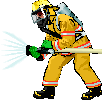
  1. bombero.gif
    He ... wear a uniform.
    1.   can
    2.   can't
    3.   has to
    4.   doesn't have to
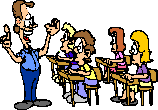
  2. interesante.gif
    They ... pay attention.
    1.   can
    2.   can't
    3.   have to
    4.   don't have to
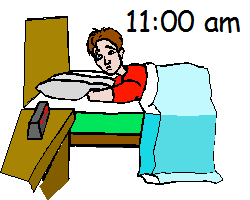
  3. tarde.gif
    He ... stay in bed late.
    1.   can
    2.   can't
    3.   has to
    4.   doesn't have to
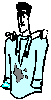
  4. sucio.gif
    He ... to wash his shirt.
    1.   can
    2.   can't
    3.   has to
    4.   doesn't have
  5. piercing.gif
    She ... have piercings.
    1.   can
    2.   can't
    3.   have to
    4.   don't have to
  6. llevarropa.gif
    She ... wear any clothes she likes.
    1.   can
    2.   can't
    3.   have to
    4.   don't have to
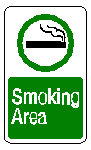
  7. fumar.gif
    You ... smoke in this area.
    1.   can
    2.   can't
    3.   have to
    4.   don't have to
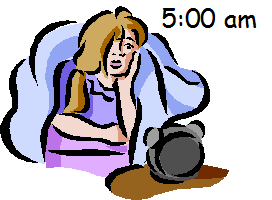
  8. temprano.gif
    She ... get up early.
    1.   can
    2.   can't
    3.   has to
    4.   doesn't have to
  9. ordenar.gif
    He ... keep his room tidy.
    1.   can
    2.   can't
    3.   has to
    4.   doesn't have to
  10. palabrotas.gif
    I ... use swear words.
    1.   can
    2.   can't
    3.   have to
    4.   don't have to
  11. nocaminar.gif
    You ... walk now.
    1.   can
    2.   can't
    3.   have to
    4.   doesn't have to
  12. fotos.gif
    You ... take pictures.
    1.   can
    2.   can't
    3.   have to
    4.   don't have to
  13. interesante.gif
    The students ... wear uniforms.
    1.   can
    2.   can't
    3.   have to
    4.   don't have to